
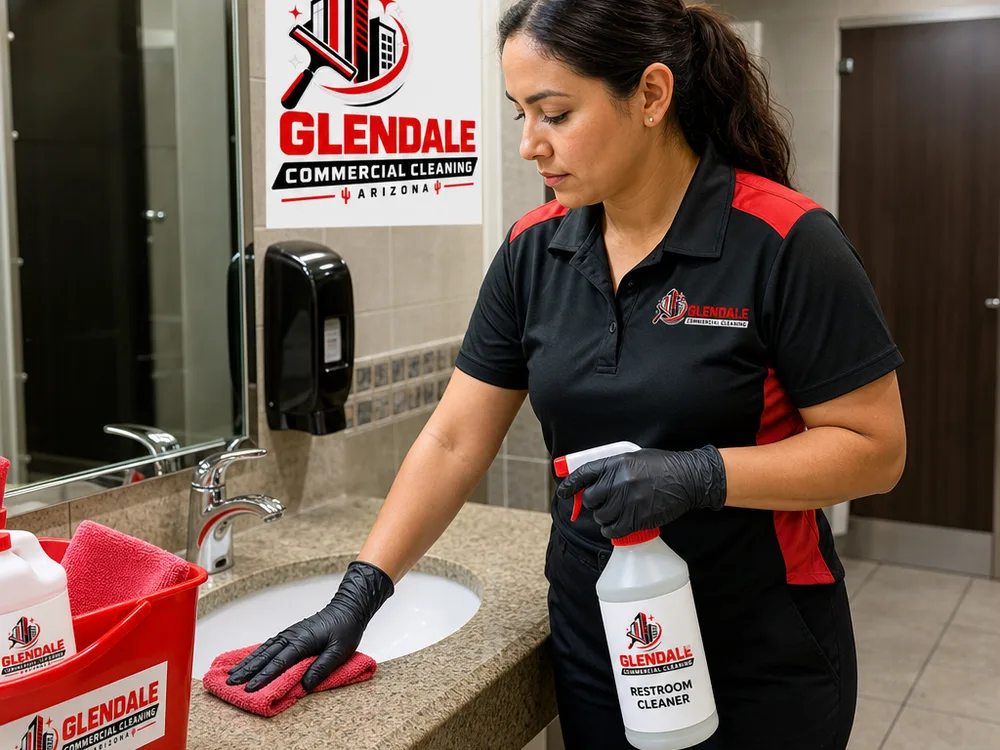
Restrooms on every visit
Fixtures, partitions, mirrors, and dispensers are cleaned and checked in one pass. Scale around bowls and faucet bases gets attention before it sets, which is what keeps odor under control.
Serving Glendale, Arizona & surrounding areas
Mon–Fri 8am–6pm · Sat 9am–2pm
Recurring Janitorial Care
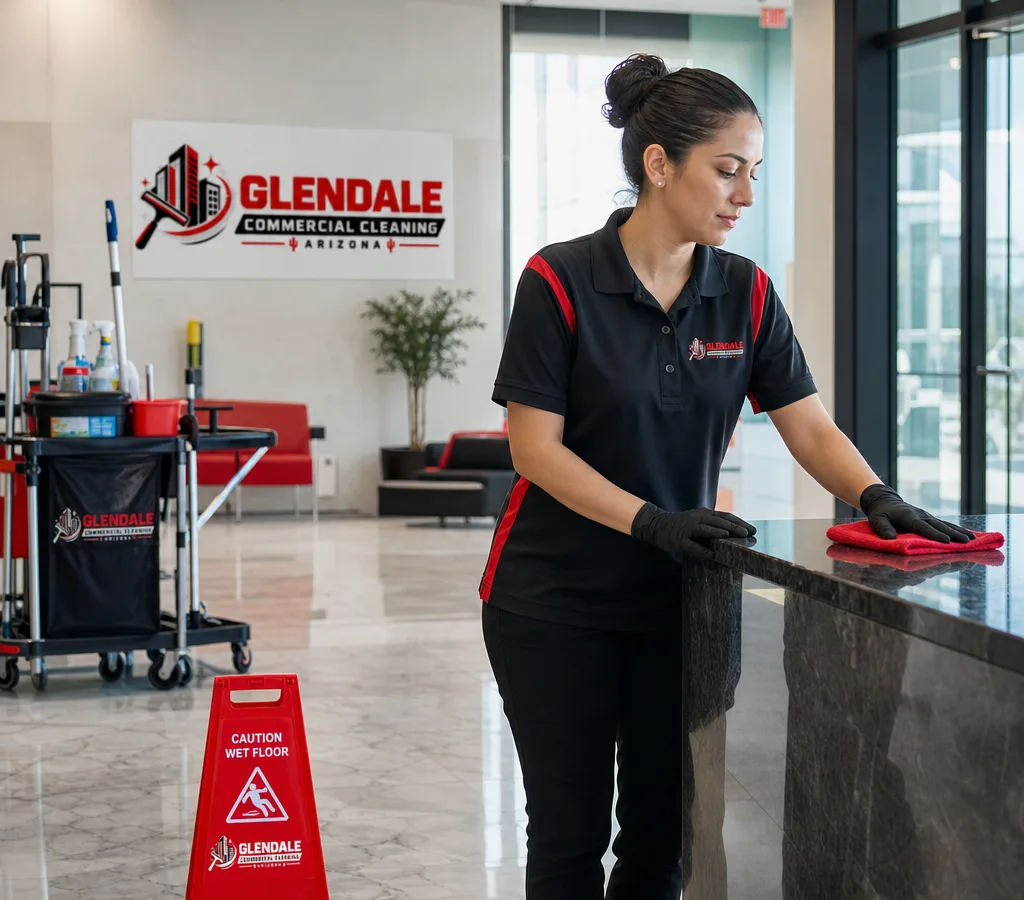
Scheduled janitorial service for Glendale businesses that need the same rooms covered on the same route every visit, from restrooms and breakrooms to trash, floors, and shared touchpoints.
The Standing Route
Recurring cleaning earns its keep through repetition. Your route lists the rooms, the tasks, and the nights they happen, so nothing depends on who is holding the cart.
Glendale Commercial Cleaning provides commercial cleaning and janitorial service for Glendale, Arizona businesses, with scopes built around your hours, traffic patterns, and actual surfaces. The plan changes between a quiet professional office, a high-touch retail floor, and a shared multi-tenant suite.
Our approach is straightforward:
You will find us near Glendale’s downtown core at 5555 N 51st Ave, Suite 5, which helps when you need reliable service coordination for multi-tenant buildings, storefronts, and office corridors where timing matters.
Route Coverage
Six areas carry most of a janitorial contract: restrooms, breakrooms, trash and liners, floors, shared touchpoints, and the supply restocking that keeps the others usable.
Fixtures, partitions, mirrors, and dispensers are cleaned and checked in one pass. Scale around bowls and faucet bases gets attention before it sets, which is what keeps odor under control.
Tables, counters, sink basins, and appliance fronts are wiped down nightly. Microwave interiors and refrigerator exteriors sit on a named rotation instead of waiting for somebody to complain.
Bins are emptied and relined across offices, restrooms, and common areas. Desk-side containers can be added to the route where your team would rather have them collected than carried out.
Carpet is vacuumed and hard floors are dust-mopped and damp-mopped, with edges and corners worked on a set rotation so grit does not bank up along the baseboards.
Door hardware, light switches, handrails, and counter edges are disinfected on the same pass. Those surfaces take the most hands per day and show the least when they are missed.
Paper goods, soap, and liners are refilled from stock held onsite, and anything running low is flagged in writing so ordering happens before a dispenser sits empty.
Scope On Paper
A janitorial scope is only useful if it names rooms and tasks separately. Vague coverage is what turns a contract into a monthly argument about whether something was included.
Core janitorial cleaning often includes:
Optional add-ons include interior glass, high dusting, employee-kitchen degreasing, and consumables tracking by request.
Many Glendale facilities prefer a rotating weekly detail list, allowing the space to stay sharp without turning every visit into a deep clean.
Hours And Access
Access decides more about a janitorial schedule than square footage does. Alarm codes, lockup, shared corridors, and delivery windows all shape when a cart can actually move.
Deep cleaning commonly focuses on:
Whether you manage a small Downtown Glendale office, a busy storefront, or a shared multi-tenant suite, periodic deep cleaning prevents the slow decline that makes a technically clean space feel worn.
Consistency Checks
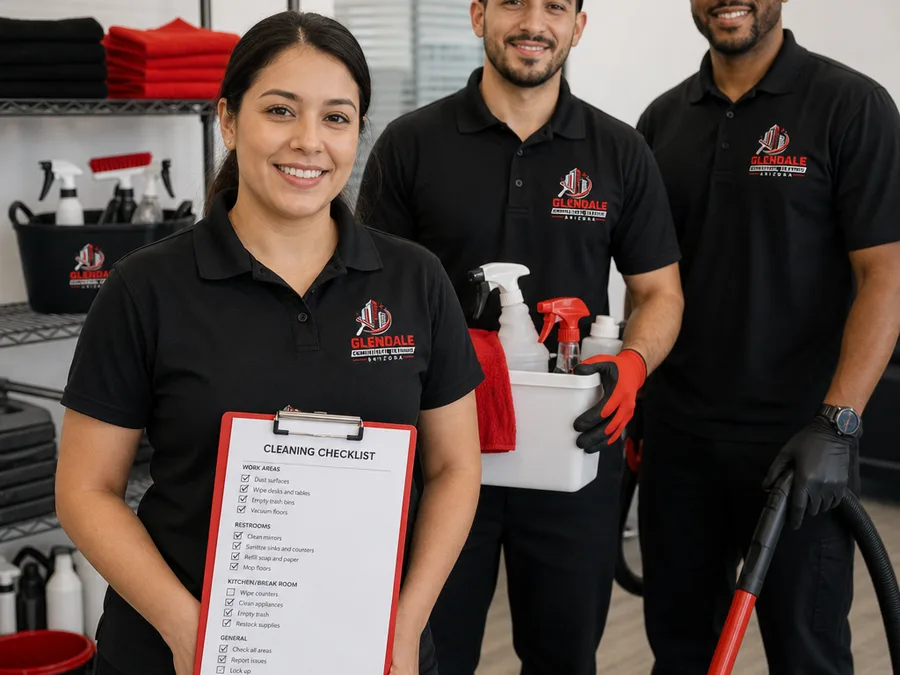
Consistency is a documentation problem more than a staffing one. Written checklists and site notes let a substitute work the route the same way the regular crew does.
Common commercial floor care work includes:
The entryway is usually the highest-wear zone. Regular edge work and targeted attention near doors helps stop grit from becoming scratches or permanent haze.
Scope Boundaries
Recurring visits protect a condition your building has already reached, and they cannot rebuild one that slipped months ago. Knowing which side of that line a problem sits on stops you paying twice.
A practical post-construction scope often includes:
For multi-phase projects, we can schedule a rough clean between trades and a final clean at handoff.
Budget Factors
Recurring janitorial pricing tracks how much work each visit actually holds. Square footage matters, but so do restroom count, the number of separate rooms on the route, floor surfaces, and how many nights per week you want covered.
Access conditions move the figure too: a single-tenant suite cleaned after hours is simpler than a shared building with staged lockup. We confirm the number after walking the space and writing the scope against it.
Facility Questions
These come up in almost every walkthrough: how many nights a route needs, after-hours access, cover when a crew member is out, who supplies consumables, fixing inconsistency, and changing the scope later.
Frequency follows traffic and restroom use more closely than square footage. A professional suite with light foot traffic often holds up on two or three nights a week, while retail floors and shared restrooms usually need nightly attention. Frequency is set per area during the walkthrough, so a low-use storage wing is not visited as often as your lobby.
Yes. After-hours work is the default for offices and retail in Glendale, and start times are set around your closing routine rather than a fixed window. Alarm codes, key handling, and lockup steps are documented before the first visit. If your lease restricts corridor or elevator use at night, the route is planned around those limits.
Site notes and the written checklist travel with the route, not with a person. A substitute works from the same task list, the same priority areas, and the same access instructions. Anything specific to your building (a door that locks behind you, a floor that cannot take standing water) is recorded so it never has to be learned twice.
Either arrangement works, and it gets written into the scope so nobody has to assume. Where supplies are held onsite by your team, restocking is part of the route and low stock is flagged in writing before a dispenser runs out. Where we carry consumables, the agreed items and dispenser types are listed so what arrives fits your fixtures.
Inconsistency almost always traces back to a scope that was never written down in enough detail. A room-by-room task list with frequencies attached removes the guesswork, and a completed checklist per visit gives you something to check against. When a room is wrong, the fix is written into the list so the same miss does not repeat.
Yes, and plenty of Glendale facilities do exactly that. Starting lighter is sensible when you are not yet sure how a space holds up between visits. Adding nights, rooms, or rotation items is a written change to the scope, and the checklist updates with it. Scaling back works the same way once a seasonal peak passes.
Start The Route
Tell us your hours, your restroom count, and the rooms that bother you most. We will walk the building, write the task list out by area, and propose a visit schedule you can hold us to.
Request a quote
Send the basics and we will follow up to arrange a walkthrough.